For most of my life, saving money meant one thing:
Make dollars. Spend less than you make. Put the rest in the bank.
Simple.
But after nearly 15 years around Bitcoin, I’ve started thinking about money very differently.
I still earn in dollars.
I still spend in dollars.
I still keep enough dollars available for the things I need.
But when it comes to long-term savings, I keep asking myself one question:
Why would I want to hold dollars when I can hold Bitcoin?
Dollars Are Designed to Lose Purchasing Power
This isn’t some conspiracy.
It’s how our monetary system works.
Central banks generally target positive inflation over time. That means the purchasing power of a dollar is expected to decline gradually.
Look at almost anything over a long enough period.
Homes.
Cars.
Food.
Education.
Labour.
The number of dollars required to buy them tends to increase.
We call that rising prices.
But there’s another way to look at it:
Your dollars are buying less.
And that’s where Bitcoin completely changed the way I think about saving.
Now Measure the World in Bitcoin
This is where things get interesting.
Instead of asking:
“How many dollars does this house cost?”
Try asking:
“How much Bitcoin does this house cost?”
The picture starts looking very different.
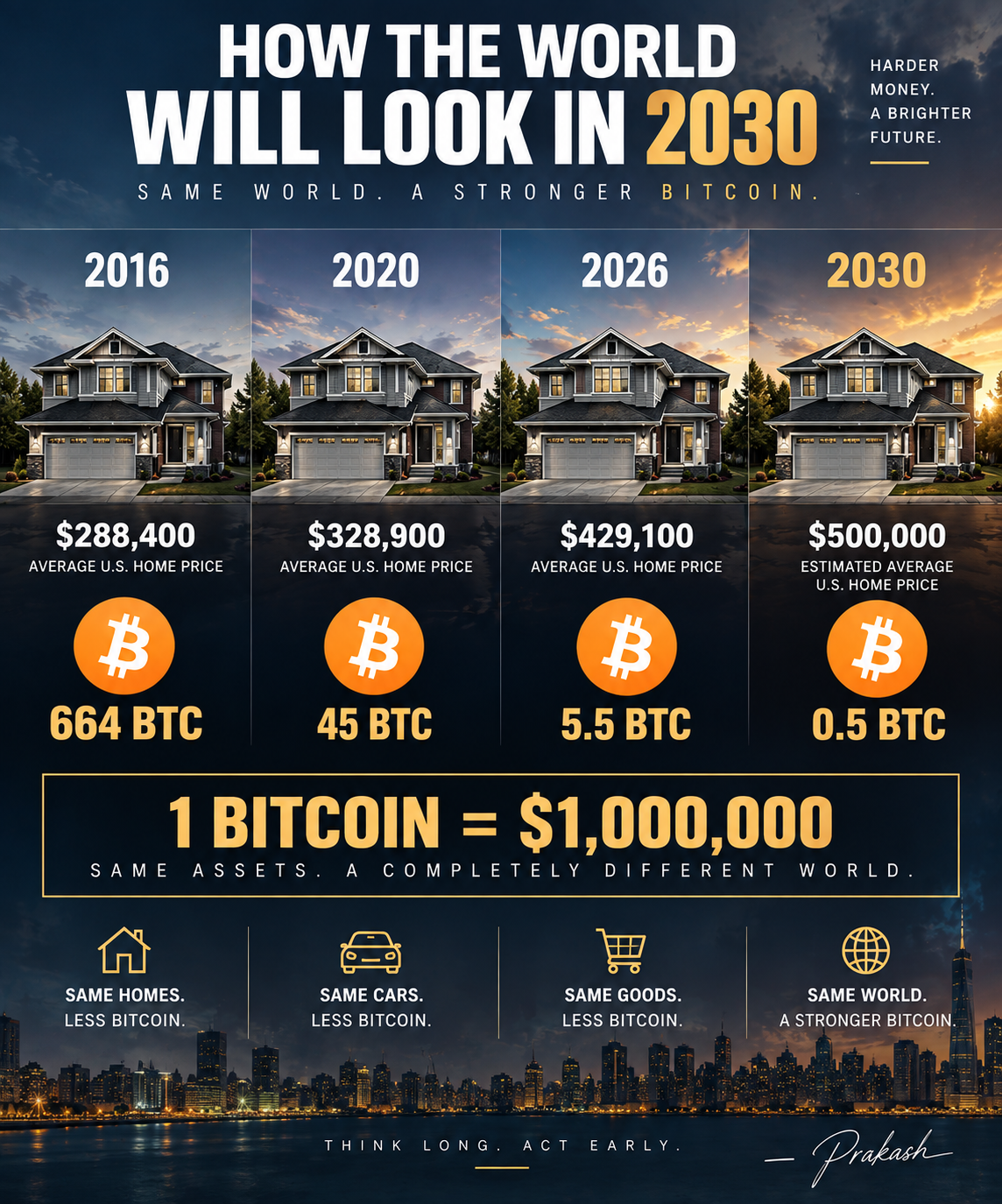
That graphic represents exactly how I think about the next several years.
The dollar price of a house may continue increasing.
But if Bitcoin appreciates faster than the house, the Bitcoin price of that same house falls.
That’s the part I think many people are still missing.
My Prediction for 2030
Let me be very clear:
This next part is my prediction. It is not a fact and there is absolutely no guarantee I’m right.
I believe Bitcoin can reach:
$1,000,000 per Bitcoin by 2030.
I’ve written before about why I believe that’s possible.
Bitcoin has a maximum supply of 21 million coins.
There are more than 8 billion people.
Institutions can now access Bitcoin through regulated investment products.
Corporations hold Bitcoin.
Governments are increasingly discussing Bitcoin.
And new Bitcoin issuance continues to decline through halvings.
I believe we’re watching a scarce global asset gradually collide with an enormous potential pool of demand.
That’s my thesis.
Imagine a $500,000 House
Let’s make the math ridiculously simple.
Suppose the average U.S. home costs $500,000 in 2030.
And suppose I’m right and Bitcoin reaches $1 million.
That house costs:
0.5 BTC.
That’s what fascinates me.
People constantly ask:
“How much will my Bitcoin be worth in dollars?”
I increasingly think that’s the wrong question.
I want to know:
How much will the things I want cost me in Bitcoin?
A house.
A car.
Travel.
My children’s education.
My retirement.
My time.
Because ultimately, that’s what money is for.
I’m Not Saying Get Rid of Your Dollars
I want to make this distinction very clear.
You need liquidity.
You have bills.
You have expenses.
You need emergency savings.
And Bitcoin can be extremely volatile.
I’m not suggesting somebody take every dollar they have and convert it into Bitcoin.
What I’m questioning is something different:
Why do we automatically assume dollars are where long-term wealth should sit?
That’s the assumption Bitcoin challenged for me.
I use dollars as a medium of exchange.
But increasingly, I think about Bitcoin as a long-term store of wealth.
There is a huge difference.
I Earn in Dollars. I Spend in Dollars. I Save in Bitcoin.
That’s probably the simplest way I can explain my philosophy today.
Earn in dollars.
Spend in dollars.
Keep enough dollars for life.
But when I’m thinking years or decades into the future?
I want Bitcoin.
Could Bitcoin fall 30%, 40% or 50% along the way?
Absolutely.
It has before.
Could my $1 million prediction be wrong?
Absolutely.
Bitcoin carries real risk, and nobody knows its future price.
But I’m not making this decision based on what Bitcoin does next Tuesday.
I’m thinking about 2030, 2040 and 2050.
And when I ask myself which asset I’d rather hold for that journey—an asset whose supply can expand indefinitely or one permanently capped at 21 million—
I know which one I choose.
Bitcoin.
My view hasn’t changed: think long, act early. — Prakash
